
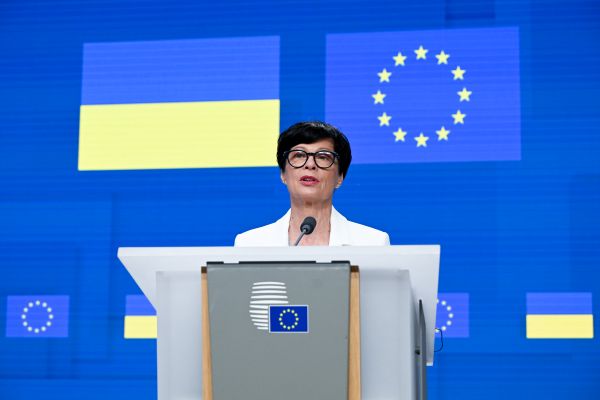
On 14 July, four countries aspiring to join the European Union took significant strides towards membership, marking one of the most substantial enlargement efforts in over two decades. Intergovernmental conferences were held in Brussels to ceremonially inaugurate or conclude negotiation tracks for the leading candidates: Albania, Montenegro, Moldova, and Ukraine.
However, it is important to note that it may still take several years before any of these countries officially becomes an EU member. While it is uncommon to conduct four meetings in a single day, it is noteworthy that ten countries, primarily from Central Europe, joined the EU in 2004. Croatia remains the most recent member, having been welcomed into the world’s largest trading bloc in 2013.
“We have not seen this in more than two decades. The last time was in 2002. This is a Super Tuesday for EU enlargement and Ukraine is part of it,” Enlargement Commissioner Marta Kos told reporters.
Tuesday’s developments indicate significant political and geostrategic shifts in Europe. In 2019, French President Emmanuel Macron stated he would block EU enlargement until deep reforms were made. However, the war in Ukraine has changed this stance.
The EU is now encouraging reforms in candidate countries due to concerns about Russia and China. Ukraine applied for EU membership in 2022, just days after Russia’s full-scale invasion, viewing it as a “security guarantee” for its future. While NATO membership would provide stronger security, the Trump administration has ruled it out, and other NATO members are cautious, given the ongoing conflict.
European countries see the war as an existential threat, fearing that Vladimir Putin might target them if he succeeds in Ukraine.
“The case for Ukraine’s EU membership is very strong,” Kos said.
“The future security architecture of our continent is unimaginable without Ukraine,” she said. “Ukrainians have turned their country into a military powerhouse with capabilities few other nations can match, especially with its rapidly evolving drone technologies.”
The prospect of EU membership motivates pro-democratic reforms and boosts trade and jobs, particularly in the Balkans, which suffered wars in the 1990s. Most EU candidates are from this region, where countries must negotiate 35 policy areas, or chapters, encompassing sectors like agriculture, taxation, and trade— a process that can take years.
Recently, Ukraine and Moldova began discussions on five chapters related to EU core values, including the rule of law and fundamental rights. They also started negotiations on foreign relations and security policies.
Albania will meet to provisionally close chapters on science, education, and external relations. At the same time, Montenegro aims to finalise negotiations on competition policy and customs rules as it aspires to join the EU by 2028.
Orbán’s electoral defeat made things start moving
A significant development contributing to the European Union’s accelerated pace in membership negotiations is the recent change in government in Hungary. The accession process for Ukraine had previously been impeded by Viktor Orbán, the former prime minister, who maintained a strongly nationalistic stance and was perceived as one of Russia’s most prominent allies in Europe, potentially posing a risk to the EU initiative. The candidacies of Ukraine and Moldova were interlinked, preventing either from advancing independently.
In a noteworthy electoral shift in April, Orbán was removed from office after 16 years of governance. During his administration, he utilised voting regulations that mandate unanimous agreement among all 27 EU member states on various rules, sanctions, and political statements. This requirement for consensus applies to both the opening and closing of each negotiating chapter.
Currently, nine countries are recognised as official candidates for EU membership: Albania, Bosnia and Herzegovina, Montenegro, North Macedonia, Serbia, Georgia, Moldova, Ukraine, and Turkey. However, the accession negotiations for Georgia and Turkey are currently on hold due to concerns about their democratic standards. Additionally, Kosovo has submitted an application to join the EU but has yet to receive candidate status.
This article used information from The Associated Press.
