
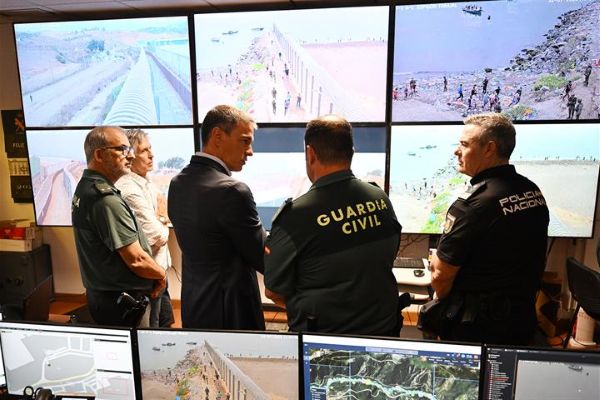
A day after tens of thousands of Spaniards protested the government’s handling of the Ceuta border crisis, Prime Minister Pedro Sánchez struggled to answer lawmakers’ questions about the incident, particularly Morocco’s role in the mass crossing in July. Despite Sánchez rejecting claims of Moroccan officials orchestrating the incident, he admitted that Moroccan police “allowed the border to be crossed.”
Sánchez announced that key reports on the border breach would be released but did not specify when. He elevated the official death toll from the event to 141, a significant increase from the previous estimate of 96, without clarifying how these numbers were calculated.
The humanitarian crisis in Ceuta, which has seen thousands of migrants flood into the small community, has drawn heavy scrutiny and angered residents. Conflicting statements by government officials have added to the confusion. On Wednesday, protests erupted demanding solutions and calling for Sánchez to resign.
“Why are you afraid of Morocco?” asked opposition leader Alberto Núñez Feijóo of the conservative People’s Party. Most migrants who entered Ceuta have since returned to Morocco, but around 5,000 individuals, including 1,200 minors, remain. Sánchez has attributed the crisis to a misinterpretation of a Supreme Court ruling and social media disinformation, and he accused accounts linked to Russia and Israel of exploiting the situation, claims both countries deny.
Understanding Morocco’s role
Spanish Prime Minister Sánchez stated that there is no evidence linking the Moroccan government to the recent mass crossing of migrants. “No institution — whether the diplomatic service, the European Commission, or any international body — has provided solid evidence that Morocco planned or executed the incident,” he asserted.
While Spanish media reported that a police document indicated leniency by Moroccan security forces, officials clarified that it did not implicate the Moroccan government. Sánchez acknowledged that during a peak time on July 30, Morocco’s Gendarmerie police allowed crossings, but they later regained control of the situation.
As concerns about Morocco’s role have grown in Spain, Sánchez affirmed he would await solid evidence before concluding. He also condemned remarks by Moroccan ministers questioning the sovereignty of Ceuta and Melilla, prompting Spain to summon Morocco’s ambassador in Madrid. The Moroccan Foreign Ministry has not commented on these developments.
This article used information from The Associated Press.
